Exhibition Stands Proven to Perform: A Practical Guide for Australian Exhibitors

Not all exhibition stands perform the same. Some generate high-quality conversations and pipeline, while others simply “feel busy”.

As exhibition costs continue to rise across Australia, scrutiny from leadership increases and marketing and event teams feel additional pressure to justify every dollar spent.

Everyone wants to create show stopping designs that pull crowds and become the talk of the show. What’s changing in the market right now, is the expectation for an exhibition stand design to not only look great but deliver measurable business results.

Most exhibition stands are designed to be seen. But the best exhibition stands are now those that perform.

For most B2B brands in Australia, the conversation is shifting from delivering big, flashy stands and activations that “wow” to ones that meaningfully connect with customers and delivery tangible results.

There is now a stronger demand for exhibition stands that convert attention into meaningful engagement and improve ROI.

As the focus moves from aesthetics to performance, the way exhibition stands are designed and delivered also needs to change.

The goal is now proof of performance and justifying spend while maintaining creativity.

In this guide we explain the physical design decisions that influence exhibition stand performance, including layout, messaging hierarchy, visitor flow and engagement zones.


What “Performance” Actually Means in Exhibition Stands

A high performing exhibition stand attracts the right audience, and the design supports quality conversations.

Lead quality and measurable engagement are key objectives so design must support that. A high performing trade show stand creates natural flow, removes friction and gives the sales team confidence to engage in focused, high quality conversations.

Every element is designed to work hard and together it delivers an experience that supports its key objectives and contributes to pipeline growth.

It might mean delivering a 6×6 instead of a 9×6, if the decision lightens investment load so other areas (like messaging or engagement) can influence performance more effectively.


The 5 Physical Factors That Influence Stand Performance


1. Layout and Flow

Open layouts make it easier for visitors to step inside and engage.

Where an exhibit is positioned on the floor plan can greatly impact visibility and how hard the team needs to work at attracting audiences. When attendees arrive at your exhibition stand, the layout is critical to how easily they can enter, engage and move through the space.

In Australia, closed off booths with minimal entry points typically don’t perform well. They force sales teams to work the aisles and pull people into their space. Not surprisingly, it’s often a team who has previously felt this, that start relying on activations to attract audiences.

Attendees are spending less time wandering halls and when they arrive at an exhibit, the design shouldn’t have any friction points preventing them from entering the space.

Research from the Center for Exhibition Industry Research (CEIR) shows that 76% of trade show attendees plan which exhibitors they want to visit before arriving. This means your stand layout and messaging need to work immediately when visitors reach your space. *Source: CEIR

The goal is for people to enter freely while following a guided journey that shares what the business has to offer.

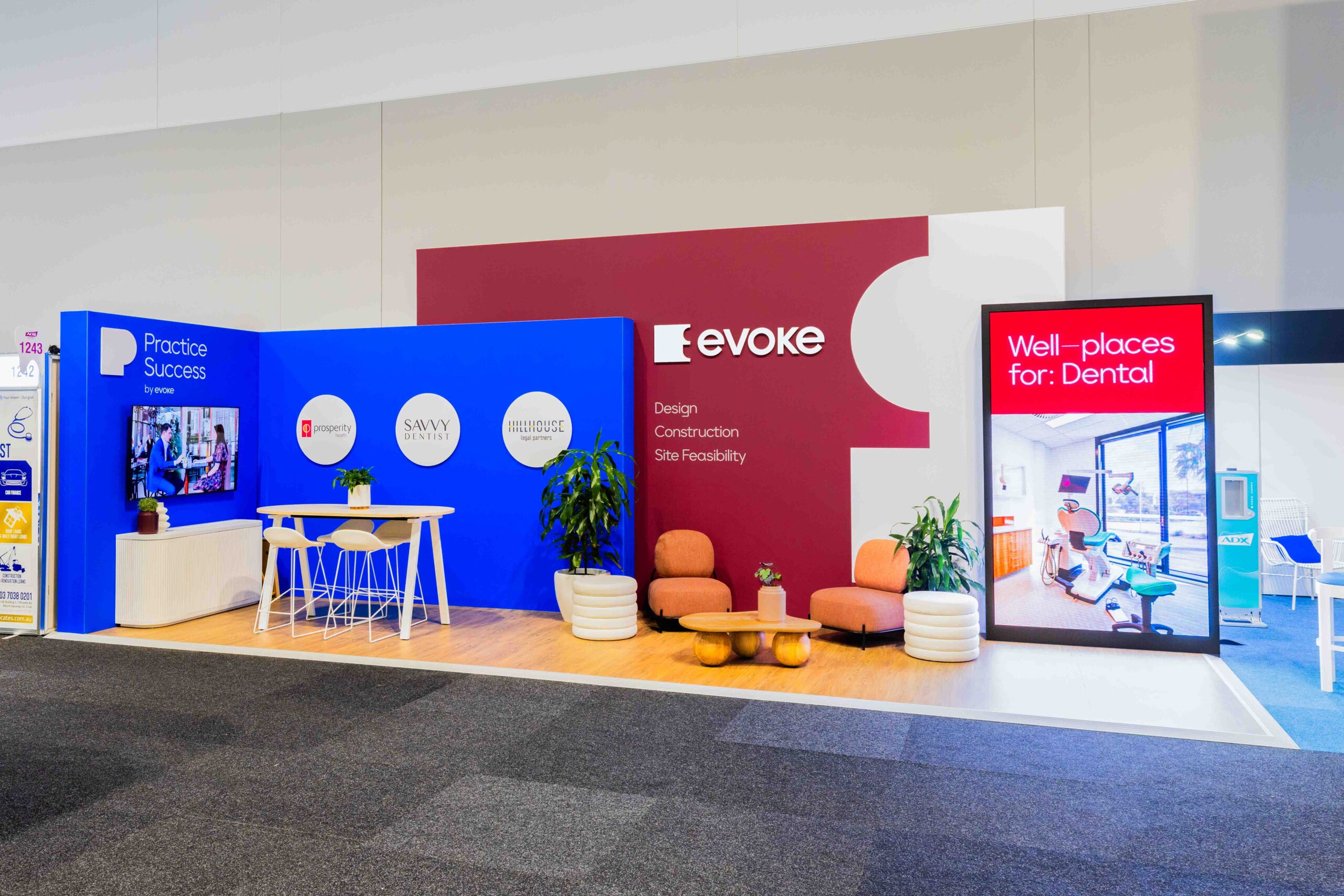
exhibition stand layout design example

2. Visibility and Messaging Hierarchy 

Clear messaging helps visitors understand the value of stopping at a stand.

While some brands we work with have highly recognisable logos that pull crowds just to see what’s new in their range or offering, what usually gets the most visibility is a highly targeted message that speaks directly to a visitor’s pain or aspiration.

WIIFM is an acronym most of us know. “What’s in it for me?” needs to be front of mind when choosing stand messaging. Customer led messaging should always take priority over internal brand statements. This is what pulls people off the aisles and into meaningful engagement.

Sandvik TV wall


3. Conversation Zones

 Different conversation zones allow visitors to engage at different levels.

Seating is often one of the most highly prized furniture pieces by teams, but it needs to be designed into a space to support sales conversations. Unless your team are speaking to a person who has shown considerable interest, in Australia, casual standing conversations tend to convert better.

Aisles, kiosks, product zones and seating in meeting areas are all fair game as exhibition conversation zones. Teams who understand how each of these environments serves a different purpose tend to shine.

What is vital to remember is that sitting down is a commitment. An attendee will assess where they see value and voting with their time.

exhibition stand conversation zones

4. Effective Use of Space

There is nothing wrong with large exhibition stands – we have built many. The opportunity lies in aligning stand size with budget and performance objectives from the early planning phases.

As an exhibition stand builder, there is nothing more challenging than trying to stretch a small budget across a large footprint. Or fit too much product into the design layout.

It places unnecessary pressure on marketing and event teams and often caps creativity because the focus is on delivering something, instead of the right thing.

In many cases, selecting a smaller stand space allows greater investment in layout, messaging and engagement – the areas that ultimately drive pipeline.

With budgets tightening across Australia, the better performing exhibition stands are focusing on clearer messaging and stronger engagement outcomes.

This can only happen when space and budget are considered as part of the conversation early on in the planning phase.

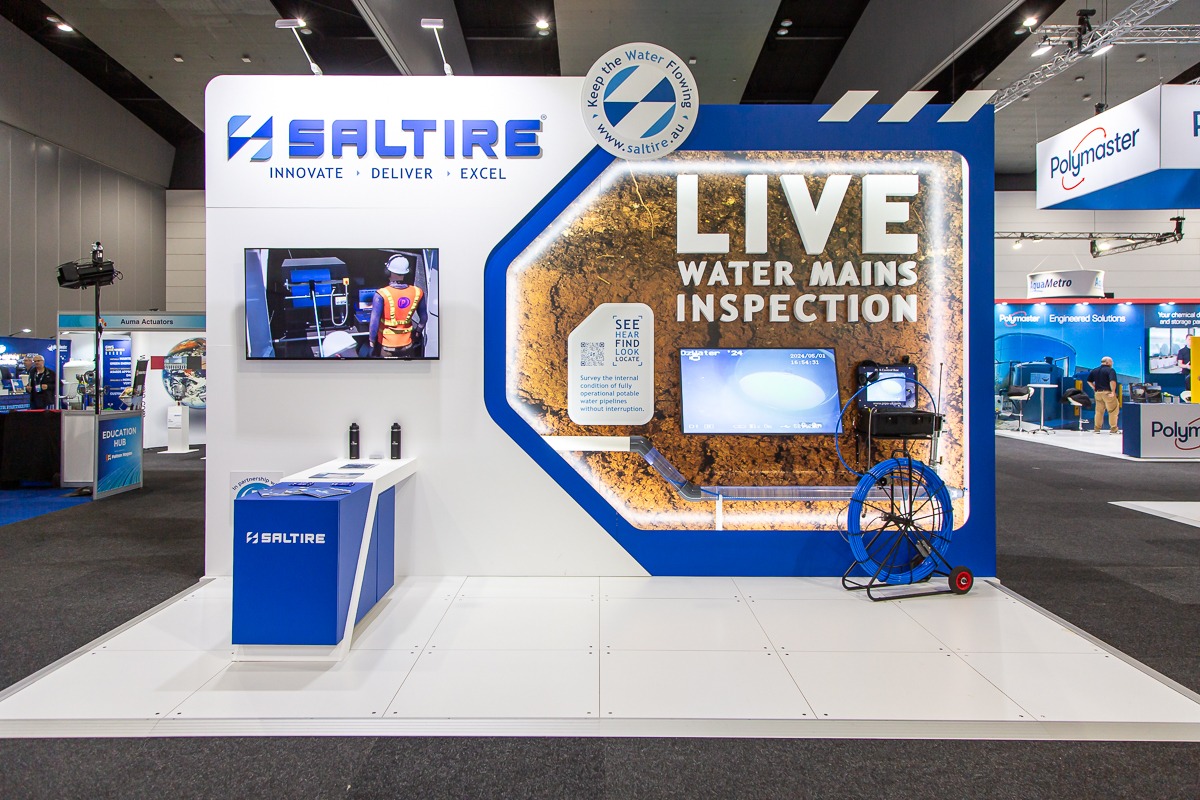
At one exhibition, Saltire Infrastructure kept the same 6×3 stand space, but we refined the execution, which resulted in 487% increase in qualified leads at the same event.

Saltire Infrastructure achieved a 487% increase in leads at the same exhibition footprint.

Saltire Infrastructure exhibition stand case study

5. Execution Quality

Execution quality affects how a brand is perceived the moment visitors approach.

The first thing to consider is how the brand needs to position itself in the market and how many times the exhibition stand will be used. Then it’s truly a balancing act and where an experienced supplier is invaluable.

In Australia, tight bump in schedules and venue access contribute heavily towards how an exhibition stand is constructed and transported.

You might need to align with the premium feel of a brand, but also have to be able to install it in under 4 hours and package in a way that minimises storage space and logistics costs.

Once a design is agreed upon, there are many different materials, lighting and finishes that can be used to produce a similar look. Selecting those that meet budget and still deliver on expectations is the real skill.

The expertise lies in balancing durability, transport requirements and brand presentation without compromising performance.

If it’s a reusable exhibit, the longevity of it will largely be dependent on how the stand is packaged. Our exhibition storage crates are as important as the stands themselves.

Should it get knocked about in transport or on site, this is where the investment protects future installations and allows businesses to amortise costs over time.

Sustainability is also becoming an increasingly important consideration for exhibitors across Australia. Designing stands that can be reused across multiple events, transported efficiently and maintained over time not only reduces environmental impact but also protects the long-term value of the investment.

exhibition stand build quality

Why Similar Stands Perform Differently

Two companies can invest the same budget, on the same size stands, at the same event, and walk away with two very different outcomes.

One could have high-quality conversations that convert into business. The other could have a stand that “felt busy”, created a lot of work for the team after the event, but ultimately delivers little commercial value.

We’ve seen identical stand footprints at the same exhibition produce completely different outcomes simply because one encouraged natural entry and conversation, while the other unintentionally blocked it.

The difference is rarely the size of the stand or the amount spent on the build. More often, it comes down to how clearly the stand environment supports the intended visitor experience.

Small design decisions like layout, messaging placement, entry points and conversation zones can dramatically influence how people interact with the space.

When a business approaches exhibition planning with clarity, those decisions become easier to make. Everything from stand position on the floorplan to finishes, layout and messaging begins to work together.

Because exhibitions are not controlled A/B experiments, it can be difficult to pinpoint exactly why one stand performs better than another.

However, after nearly four decades in the industry, we consistently see that stands designed around a clear purpose outperform those driven purely by aesthetics.

A simple example is the key message on the stand. Without clarity on what the business wants visitors to understand or do next, messaging often becomes diluted or overly broad.

When messaging is clear, it guides both the stand design and the conversations that take place within it.


Does a Bigger Stand Guarantee Better Results?

There’s an assumption that bigger is better. In some ways, it is true – you usually get first dibs of the best positions on the floorplan, but it’s important to weigh up your reasoning behind why you want that spot and how you’ll make the most of it.

If your competition are in the bigger spots, you absolutely want to be there. The last thing you want is to get a smaller stand and be dwarfed.

There are some advantages to being right next to your competition – Visitors may not have thought of you and stumble up you and you have an opportunity to clearly state your point of difference and outshine the opposition.

Visitors will only be able to draw that conclusion themselves if your approach is right. It is critical your approach, team and design compliment what you are trying to achieve by being at the event.

A bigger space can increase flexibility in your design choices and what activities can take place on your stand, but it can also dilute focus. We’ve seen teams want to bring all of their equipment or start plotting additional activations, or lounge areas for entertaining just because they have the space to do so.

If you haven’t cottoned on yet, there’s a running theme that keeps appearing in this article…

Clarity drives performance and every decision surrounding the stand environment. Without it, everything is a gamble and that is when exhibitions start feeling really expensive and hard to justify.

Avoiding these common mistakes is often the difference between a stand that simply looks impressive and one that actually performs.


5 Common Exhibition Stand Mistakes That Reduce Performance

After working on exhibition stands for nearly four decades, one thing has become clear, poor stand performance is rarely caused by budget or space alone.

More often, it’s the result of small design decisions that unintentionally make it harder for visitors to engage with the stand.

These mistakes are common, but once you know what to look for, they’re surprisingly easy to avoid.

1. Designing for internal stakeholders, not visitors 

One of the most common mistakes in exhibition stand design is prioritising what internal teams want to see instead of what visitors need to understand.

Sometimes this comes out as brands trying to communicate too many things at once, resulting in messaging that feels diluted or confusing from the aisle.

Visitors are making split-second decisions about where to stop. If the message isn’t immediately clear or relevant to them, they simply keep walking.

2. Blocking natural entry points 1. Designing for internal stakeholders, not visitors 

Sometimes the most visually striking stands unintentionally create barriers to entry.

Raised platforms, enclosed walls or furniture positioned too close to the aisle can make visitors feel as though they’re interrupting rather than being invited in.

The most effective exhibition stands make it obvious where visitors should enter and allow them to do so comfortably.

3. Over-designing and under-thinking flow

It’s easy to focus on making a stand look impressive, but without considering how people will move through the space, even a beautiful stand can feel awkward to navigate.

A high performing exhibition stand balances visual impact with clear movement pathways so visitors naturally transition from first contact to a conversation. It goes further than just access points and flow through the aisles, the best stands have the customer journey woven into their designs.

“An exhibit should look empty, until it is working”, Chris Lamb, Founder and Project leader at The Exhibit Company

4. Prioritising wow-factor over usability

Interactive elements and live stand demonstrations can be powerful engagement tools when they support the broader experience. It absolutely must tie back to the narrative of the stand rather than just being an add on to pull crowds.

The strongest stands balance attention-grabbing moments with practical spaces where real discussions can happen naturally.

5. Briefing builders without clear objectives

Exhibition stand builders are incredibly skilled at bringing ideas to life. However, without clear objectives, even the best suppliers are forced to interpret what success might look like. What they design and go on to build, is an interpretation of what is in the brief.

Clear direction around goals, messaging and an engagement strategy allows builders to make better decisions about the suggested layout, materials and functionality.

Many of these decisions begin well before stand design starts, during the early planning phases of an exhibition strategy.


Designing Exhibition Stands That Actually Perform

When exhibition stands are designed with performance in mind, they stop being temporary marketing displays and start becoming real business assets.

The most effective stands don’t just look impressive on the show floor. They create environments where the right conversations happen naturally, where teams feel confident engaging visitors, and where marketing investment translates into measurable outcomes.

For many B2B brands, exhibitions remain one of the few places where customers, competitors and partners gather in the same space. People come looking for what’s new. When the stand environment supports that interaction properly, the impact extends far beyond the days of the show itself.

The goal shouldn’t be to build an exhibition stand.

The goal is to build one that performs. 

Frequently Asked Questions

What makes an exhibition stand perform well?

An exhibition stand performs well when it’s designed with clear intent. Performance isn’t about size, budget, or visual impact alone. It’s about how effectively the stand supports engagement on the show floor. Layout, visitor flow, messaging and how conversations are initiated all play a critical role.

When these elements are aligned, the stand doesn’t just attract attention, it helps the right people stop, engage and have meaningful conversations.

Can two exhibition stands with similar budgets perform differently?

Absolutely. We see this all the time. Two exhibition stands with the same footprint and similar budgets can deliver vastly different results depending on the decisions made during planning and design.

How the space is used, where conversations happen, and how visitors are invited in often has a far greater impact on performance than spend alone. This is why some stands feel busy but ineffective, while others generate fewer, but far more valuable, interactions.

How does stand layout affect engagement on the show floor?

Stand layout directly influences how people move, where they pause and whether conversations start naturally or feel forced. Poor layout can create bottlenecks, confusion, or hesitation, while a well-considered layout guides visitors comfortably into the space and through the interaction.

Designing for flow, visibility, and ease of interaction helps remove friction and allows conversations to happen more naturally, which is often the difference between surface-level interest and genuine engagement.

Does a bigger exhibition stand guarantee better results?

No. A bigger stand does not automatically lead to better results. While additional space can appear to be a better status symbol, offer more flexibility and sometimes be in better positions on the floorplan, performance still comes down to how effectively that space is used.

Without clear intent, for both the team on the stand and the visitors, every decision from floorplan selection, to design and ultimately performance suffers.

Are reusable exhibition stands more sustainable?

Reusable exhibition stands can be significantly more sustainable than single-use builds, particularly when they are designed with longevity and transport efficiency in mind.

Part of designing a stand that delivers strong return on investment is ensuring it can be used across multiple events without excessive rebuilds or unnecessary transport costs. Wherever possible, we aim to reduce the size and complexity of what needs to be transported around the country while selecting materials that are durable and responsibly sourced.

When done well, this approach supports both commercial outcomes and sustainability goals, allowing businesses to maximise the life of their exhibition investment while reducing waste over time.

Designing reusable exhibition stands that travel efficiently between events allows businesses to maximise value while reducing material waste.